EV BMS Block Diagram
EV BMS Block Diagram
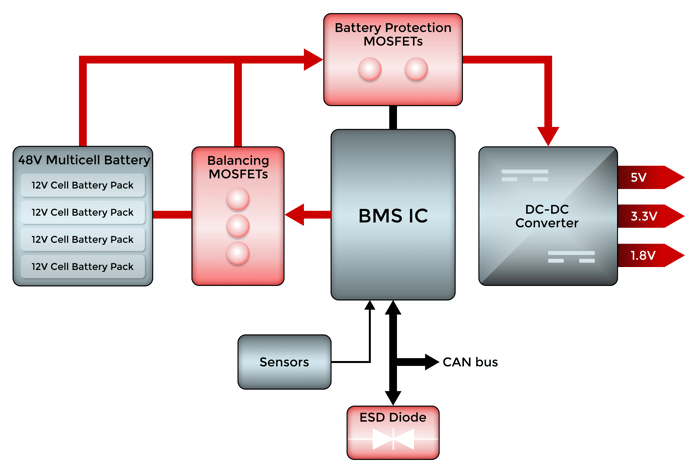
Design Considerations
Compared to other parts of the vehicle, the EV’s battery system is the most expensive. Therefore, the BMS can make or break the performance and longevity of the EV itself. Proper component selection is key to a BMS drivers can rely on. Critical requirements include:
- Charge/discharge - cell balancing by charging and discharging of individual cells with different levels of charge can impact the overall performance and life of the battery.
- Energy efficiency - lower energy usage enhances fuel economy and requires less power from the vehicle’s battery, which improves the range for EVs.
- High-temperature capability - components must withstand the worst-case scenario in thermal surges caused by torque assistant pulses.
- High current handling - the system should perform reliably under the worst possible conditions and current surges. BMS components must provide overvoltage protection (OVP).
- ESD protection and transient suppression - in addition to protecting from high heat and current, the BMS design should provide the appropriate levels of protection from electrostatic discharge and ensure any transients are effectively managed.
- Low on-resistance - minimizing heat generated during operation extends the life of the component, and low RDS(on) plays a crucial role while enhancing system responsiveness.
- Fast switching speed - switching should be fast enough to ensure smooth operation amid ever-changing conditions.
- Low reverse recovery time - low Trr is needed to enable faster switching at high frequencies and improve efficiency.
- Applicable industry standards - for maximum safety and reliability, adherence to AEC-Q101, ISO 26262, and other standards is required for certain components.


Comments
Post a Comment