Drones in agriculture
- Get link
- X
- Other Apps
Drones in agriculture
Drones in agriculture are used to enhance and optimize various farming activities such as crop monitoring, crop spraying, soil analysis, and mapping. In fact, agriculture is one of the major sectors to incorporate drones. Drones equipped with sensors and cameras are used for imaging, mapping, and surveying farms. There are ground-based drones and aerial drones. Ground drones are bots that survey the fields on wheels. Aerial drones, formally known as unmanned aerial vehicles (UAVs) or unmanned aircraft systems (UAS), are flying robots. Drones can be controlled remotely or they can fly automatically through software-controlled flight plans in their embedded systems, working in coordination with sensors and GPS. From the drone data, insights can be drawn regarding crop health, irrigation, spraying, planting, soil and field, plant counting, yield prediction, and much more. Drones can either be scheduled for farm surveys (drone as a service) or can be bought and stored near farms where they can be recharged and maintained. After the surveys, the drones need to be taken to nearby labs to analyze the data that has been collected, thereby helping leverage IoT in agriculture better.
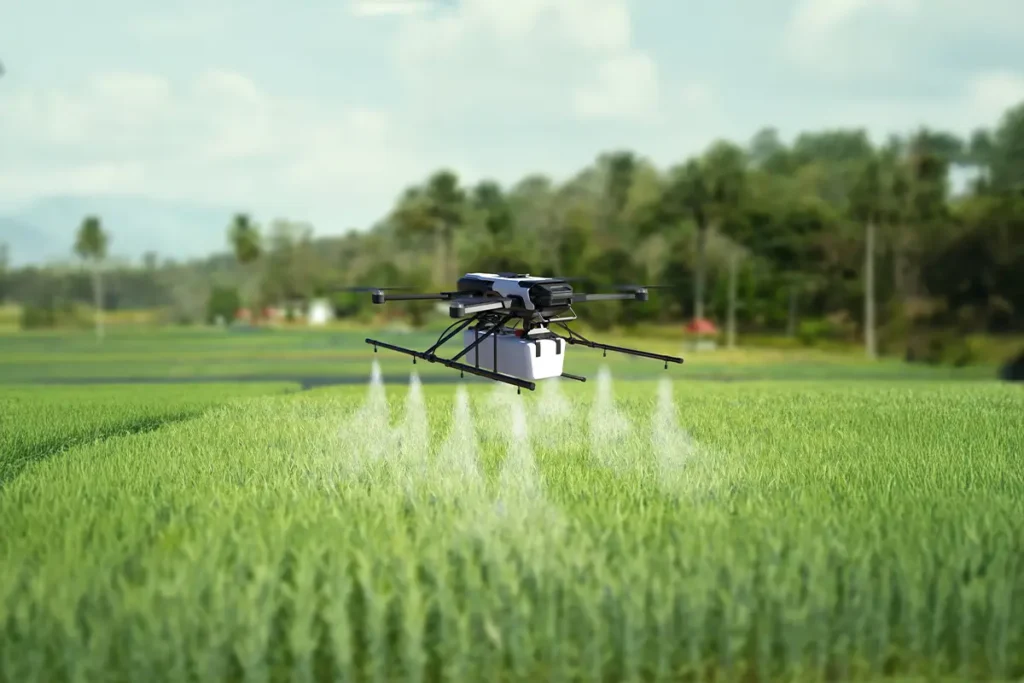 enhance and optimize various farming activities such as crop monitoring, crop spraying, soil analysis, and mapping.
 In fact, agriculture is one of the major sectors to incorporate drones. Drones equipped with sensors and cameras are used for imaging, mapping, and surveying farms.
There are ground-based drones and aerial drones. Ground drones are bots that survey the fields on wheels. Aerial drones, formally known as unmanned aerial vehicles (UAVs) or unmanned aircraft systems (UAS), are flying robots.
Drones can be controlled remotely or they can fly automatically through software-controlled flight plans in their embedded systems, working in coordination with sensors and GPS. From the drone data, insights can be drawn regarding crop health, irrigation, spraying, planting, soil and field, plant counting, yield prediction, and much more.
Drones can either be scheduled for farm surveys (drone as a service) or can be bought and stored near farms where they can be recharged and maintained.
After the surveys, the drones need to be taken to nearby labs to analyze the data that has been collected, thereby helping leverage IoT in agriculture better.
- Get link
- X
- Other Apps


Comments
Post a Comment