Semiconductor Technology
Introduction
Semiconductor technology is one of the most important emerging areas in Electrical and Electronics Engineering. A semiconductor is a material whose electrical conductivity lies between that of a conductor and an insulator. The most commonly used semiconductor materials are Silicon (Si) and Germanium (Ge). Semiconductors are the foundation of modern electronic devices.
Working Principle
Semiconductors control the flow of electrical current through the movement of electrons and holes. Their conductivity can be modified by adding impurities through a process called doping, creating:
- N-type semiconductor – Excess electrons act as charge carriers
- P-type semiconductor – Holes act as charge carriers
By combining P-type and N-type materials, devices such as diodes and transistors are formed.
Major Semiconductor Devices
- Diode – Allows current flow in one direction
- Transistor – Used for switching and amplification
- Integrated Circuit (IC) – Combines multiple electronic components on one chip
- MOSFET – Used in power electronics and switching applications
- Microprocessor and Microcontroller – Used for computation and control
Applications / Where It Is Used
- Mobile phones and computers
- Power electronics and converters
- Electric vehicles (EVs)
- Solar inverters and renewable energy systems
- Communication systems (4G/5G)
- Industrial automation and robotics
- Consumer electronics and smart devices
Advantages
- Small size and lightweight
- High efficiency and fast switching
- Low power consumption
- High reliability and long life
- Enables miniaturization of electronic systems
Future Scope
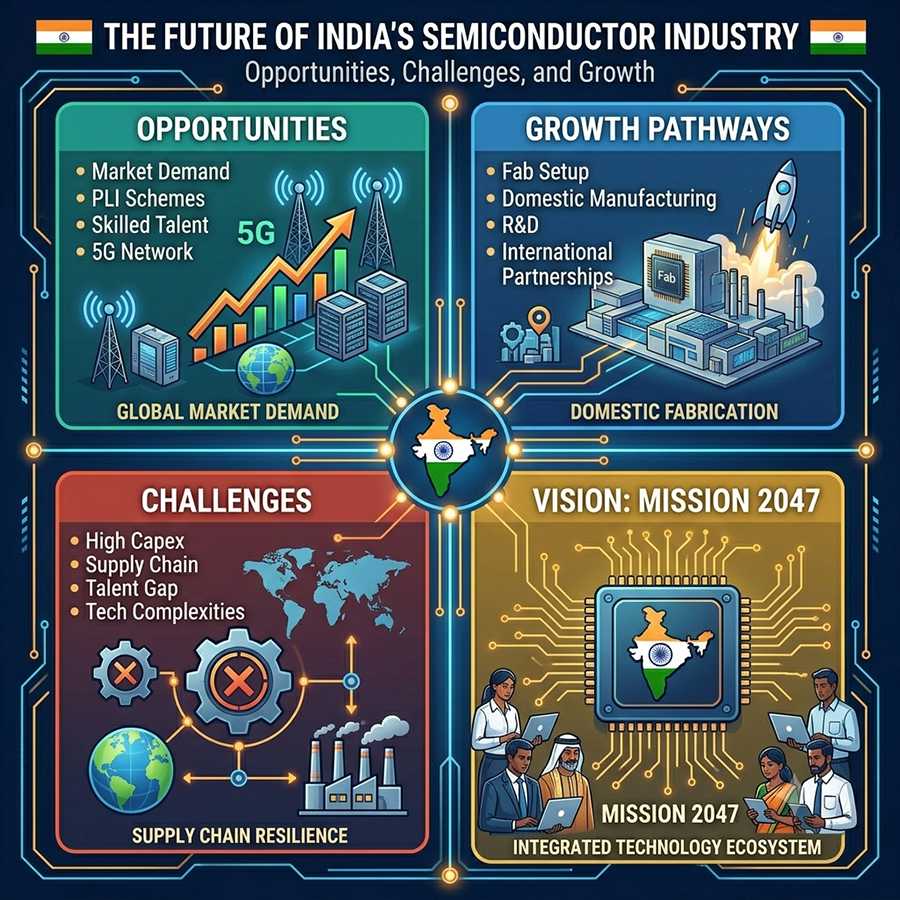
Modern semiconductor technology is advancing toward smaller, faster, and more energy-efficient chips. Technologies such as AI processors, power semiconductor devices (SiC and GaN), IoT systems, and advanced integrated circuits are driving future innovations.


Usefull nice 👍
ReplyDelete