Power Transmission System: Backbone of Modern Electrical Infrastructure
Introduction
The power transmission system plays a critical role in modern power networks by enabling the efficient transfer of electrical energy from generating stations to load centers. It ensures reliable, continuous, and economical delivery of electricity over long distances while maintaining system stability and power quality. For engineering students and professionals, understanding power transmission is fundamental to mastering electrical power systems.
Overview of Power Transmission System
Need for High-Voltage Transmission
Electrical power is transmitted at high voltage levels such as 132 kV, 220 kV, 400 kV, and 765 kV to reduce transmission losses and conductor size. By increasing voltage, current decreases for the same power transfer, resulting in lower heat losses and improved voltage regulation.
Key advantages include:
-
Reduced line losses
-
Improved transmission efficiency
-
Economical conductor size
-
Enhanced system reliability
Components of a Power Transmission System
1. Transmission Conductors
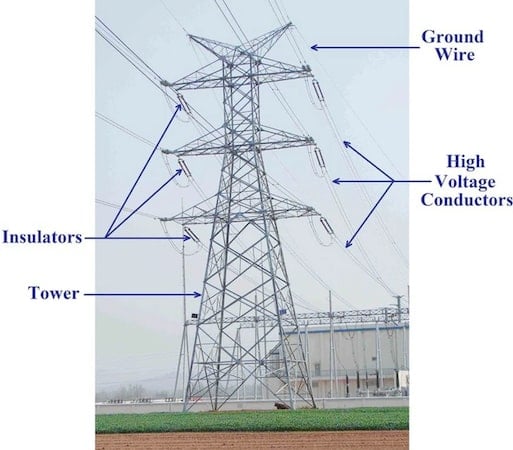
Conductors carry electrical power and are commonly made of ACSR (Aluminium Conductor Steel Reinforced) due to its high strength and conductivity.
2. Transmission Towers
Towers provide mechanical support and maintain safe clearance between conductors and the ground. Lattice steel towers are widely used for high-voltage lines.
3. Insulators
Insulators electrically isolate conductors from towers and prevent leakage current. Pin, suspension, and strain insulators are selected based on voltage levels.
4. Substations
Substations step up or step down voltage levels and serve as control points for protection, switching, and monitoring.
Types of Power Transmission
AC Transmission
Alternating current (AC) transmission is widely used due to ease of voltage transformation and simpler protection schemes.
DC Transmission (HVDC)
High Voltage Direct Current (HVDC) transmission is preferred for long-distance and bulk power transfer, undersea cables, and renewable energy integration due to lower losses and improved controllability.
Technical Challenges in Power Transmission
Despite advanced design, transmission systems face challenges such as:
-
Corona loss and radio interference
-
Insulation degradation
-
Environmental and climatic effects
-
Line faults caused by vegetation or wildlife
Modern solutions include bundled conductors, advanced insulators, real-time monitoring, and smart grid integration.
Importance in Engineering Education
The power transmission system is a core subject in electrical engineering curricula and forms the foundation for advanced studies in:
-
Power system analysis
-
Protection and relaying
-
High-voltage engineering
-
Renewable energy integration
A strong understanding of transmission systems enhances employability in utilities, industries, and public-sector undertakings.
Conclusion
The power transmission system is the backbone of electrical power infrastructure, enabling large-scale energy transfer with high reliability and efficiency. Continuous technological advancements, including HVDC and smart transmission networks, are shaping the future of power delivery systems. For engineering students, mastering this subject is essential to contributing effectively to the evolving power sector.


Comments
Post a Comment